

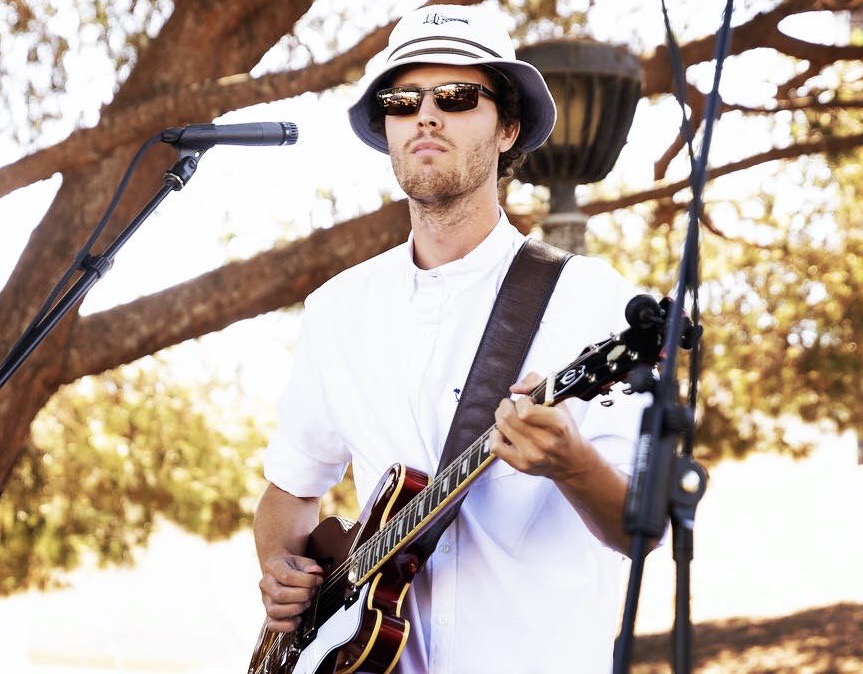
One night, 22 year old Owen Hamlin found himself onstage with his electric guitar next to Mike Pinera playing “In-A-Gadda-Da-Vida”. The former Iron Butterfly member had been invited as a special guest to join a revamped Steppenwolf on their “Born To Be Wild Tour” gig at the 2019 Washington Evergreen State Fair, and Pinera asked Owen to travel up from California to perform with him. For a fella my age, the image of young Owen on stage with a bunch of old time rock-and-rollers wailing away to one of the ultimate ’60s classics is just too cool, and brings a smile to my face every time I imagine it.
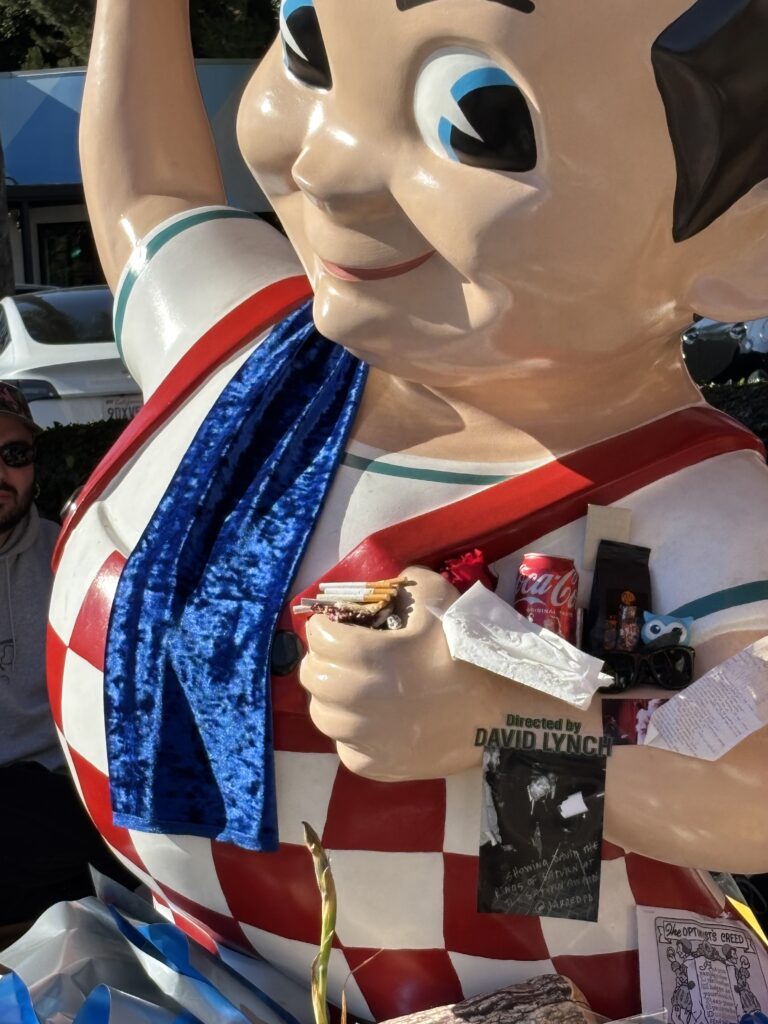
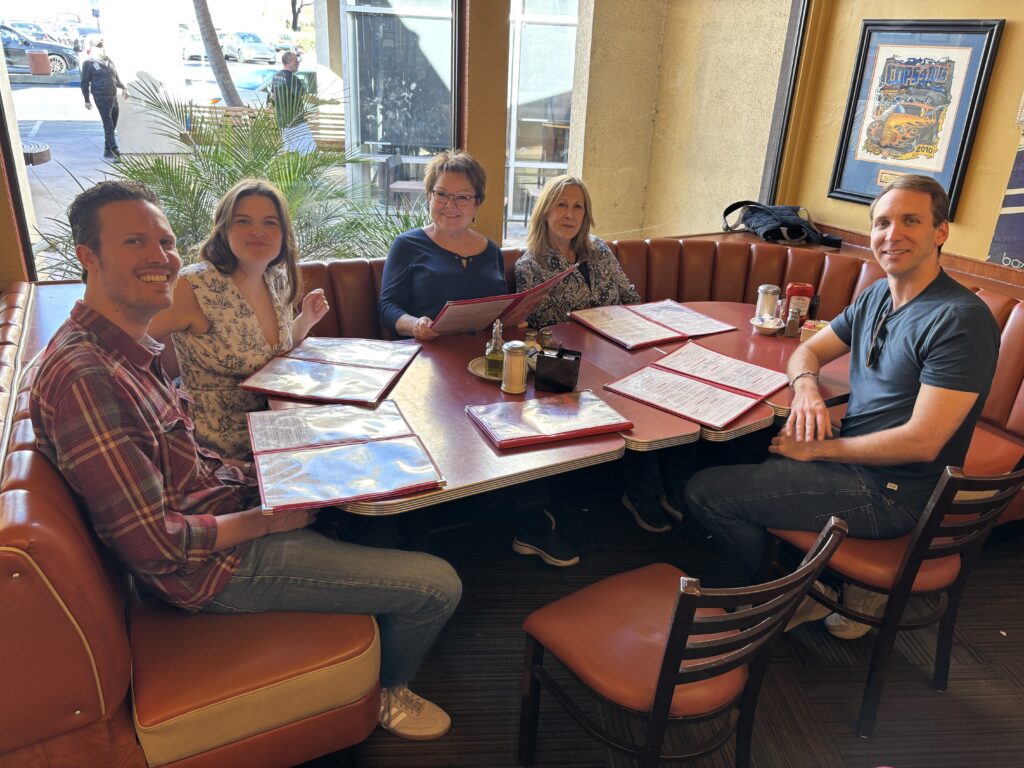
I met Owen in December, 2024, in Los Angeles at a Transcendental Meditation (TM) group meditation. Because of teacher Denny Goodman, the West L.A. TM centre may be one of the few worldwide which holds daily group meditations, and when we were spending our winters in California Barb and I seldom missed attending. But it was in January that I really started to get to know Owen. During the massive fires, Barb and I, along with a few other friends, volunteered at the Pasadena Community Job Centre which had been turned into a donation and distribution centre for water, food and clothing. Owen and his girlfriend Alexis were to join us on Martin Luther King Day but, given the holiday, we found that there were far more volunteers than jobs. Since we were already in the Valley, Owen came up with the terrific idea of attending an impromptu memorial for the recently deceased David Lynch which had emerged in Burbank at the Bob’s Big Boy. If you don’t understand why that location click here. We enjoyed the outdoor memorial, chatting up dozens of Lynch fans, before finally being seated inside to savour our own chocolate milkshakes. Owen explained to me his love of Lynch and how it was through the filmmaker that he made his way to TM. He and I have been good friends ever since.
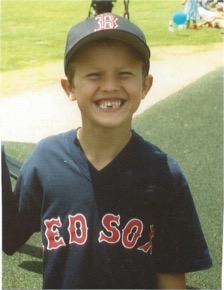
Born in Southern California in 1996, Owen grew up in Manhattan Beach, one of the three small cities that make up the costal region of Los Angeles County known as South Bay — the others are Hermosa Beach and Redondo Beach. The area is about as beautiful as you can imagine, white sand, blue ocean, palm trees and massive green succulents growing everywhere. His father was a publisher, his mom an art designer, and they met at work. Owen is the older of two boys, grew up playing little league baseball, and learning to golf not long after he learned to walk. But when it came to school, he had difficulties. He struggled academically and was diagnosed with Attention Deficit Disorder (ADD) though, looking back, Owen wonders if he was caught up in the general over-diagnoses of the early 2000’s. Regardless, he did have a learning disability and school presented a formidable challenge. With his oblique sense of humour, Owen says he was very thankful for the game of golf because he made the golf team and enjoyed nothing more than being excused from class to play in high school golf tournaments.
Whether in spite of, or because of, his academic struggles, Owen began finding refuge in his own world of writing — song writing. He started playing a musical instrument in elementary school, trumpeter in the school band, then picked up guitar at twelve years old. Funnily enough, golf became a factor. A neighbourhood guy who loved music and played guitar, but who Owen didn’t know at all, befriended him on the golf team. The neighbour was a senior when Owen was a freshman and became his first music mentor. By the time he was sixteen, Owen worked on writing songs every day and though many were not fully formed, he had over three hundred songs upon graduating high school. Many of these songs, even if partial, became the foundation of what he ended up recording in the coming years.
Although happy to have graduated high school, Owen faced a dilemma given his academic struggles. He told me his desire was to pursue music professionally but when I asked him about whether his parents discouraged him to jump into music full time without going to college first he answered, “Absolutely! My parents dissuaded me and, in addition, all my friends and peers were going to college so there was a pressure there.” The solution to this quandary came to Owen through one of the professional musicians he loved. “I became a big fan of John Mayer while in high school,” he said. He saw Mayer as someone who could “rip it on the guitar but also do pop songs that the girls loved.” (I mean, has any straight guy ever got into rock and roll for a reason other than to attract the girls?) Owen discovered that Mayer had also considered skipping college to pursue music, yet his parents wanted him to continue his education, so he created a grand compromise by attending the Berklee College of Music in Boston.

This potential solution for Owen took a couple of turns, although it ended up providing a terrific opportunity. Given his lack of high school academic credentials, Berklee wouldn’t offer him placement right away,but the school did have a partnership with Conservatori Superior de Música del Liceu in Barcelona. Owen could attend their program for one year and, if he received his credits, he would automatically be accepted as a second year student in Boston. So here’s the picture: you’re an eighteen year old upper-middle-class kid who only wants to pursue music but your parents expect you to go to college and the plan which everyone accepts is to spend a year in Spain with a hundred other like-minded teenagers. To put it much more succinctly, in Owen’s own words, “Living in Barcelona mentally seemed surreal.”
There was Owen arriving at that gorgeous Mediterranean city, home of Antonio Gaudí and Joan Miró, great influence on Salvador Dalí and Pablo Picasso, carrying with him his three hundred songs. And those songs gave him two distinct advantages, the first being that he was able to form a band with schoolmates who learned and performed Owen’s songs. In addition, there was a specific class called Combo. “The premise of Combo,” he explained to me, “was for students to be graded on how they could learn an arranged song and then perform as group.” Owen decided to approach the school principal with a very request.
“I asked to have the class be all my songs. Not just one song. And he said yes. The principal’s name was Oriol Sana. Oriol was a really awesome guy and musician, he dressed well, had a great haircut, and could play the violin like you wouldn’t believe. His guidance on the combo was subtle and yet profound. He would say things like ‘Do the lyrics matter?’ ‘Are they good lyrics?’ Myself and the guys would be like ‘Ya’ , and Oriol would say ‘Then try to deliver them more clearly when singing so people can understand them.’ I remember once he said, ‘If a band is really playing together and tight, the audience may not like the genre to their taste but they will not be able to deny its music.’
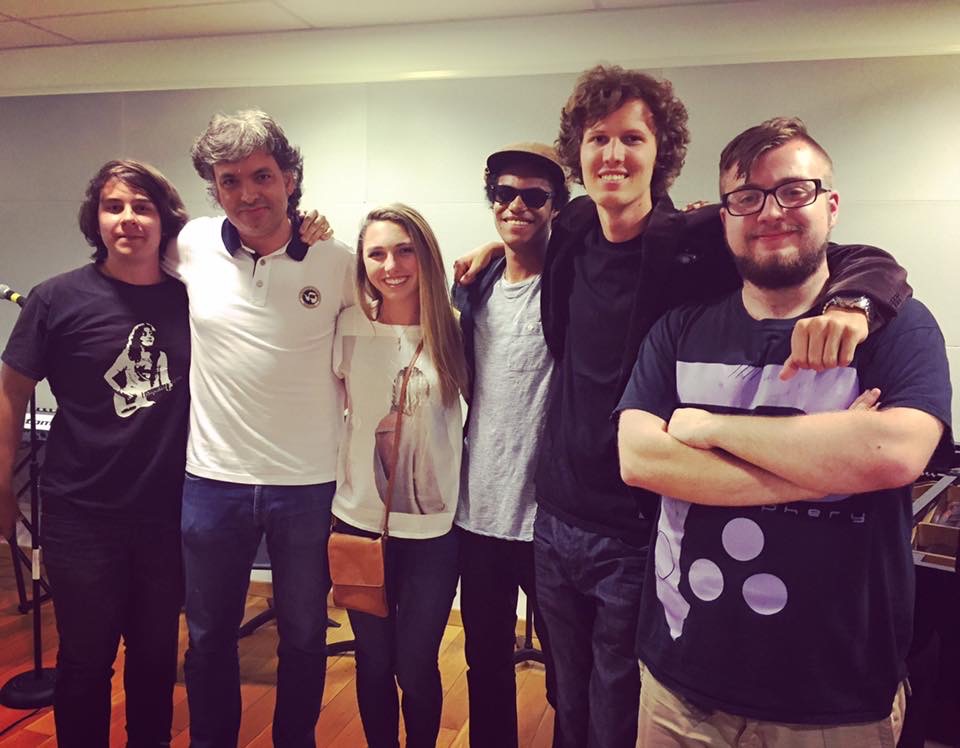
This Barcelona journey became even more meaningful for Owen. “Oriol asked me to lunch after the class had wrapped up and told me that a song of mine ‘Swimming In Your Sea’ was a hit. Bear in mind I was a guy who didn’t do so well academically and here I was sitting down to lunch with the principal of my school and receiving this wonderful compliment after having been given the opportunity to use a college class to rehearse my own music. A really great and memorable thing for me.”
That song, “Swimming In Your Sea”, is my personal favourite and became a track on Saint Augustine the second album Owen released — though the first that he recorded, but more on that a bit later.
After finishing up in Barcelona, Owen was accepted at Berklee in Boston, but struggled. He told me that his love of music was “being temporarily lost in academia,” and continued by saying that he knew “many students grappled with this sort of tension due to getting involved in music academia. Dare I say for most of us music begins as a creative, safe little outlet for self expression and Berklee can, for some, strip that away or, at the least, intrude.” One friend, who was with him from Barcelona to Boston, had become burned out, apathetic, and expressed to Owen “that with all his school work he didn’t have the time or energy to make HIS music anymore.” Writing again became Owen’s creative outlet but this time it took the form of a novel that he says was heavily inspired by the LA writer Charles Bukowski. “Most of it was written in Boston but I finished it a couple of months after returning home.” He did not seek publication for the novel but the creativity of writing it brought him back to his music.
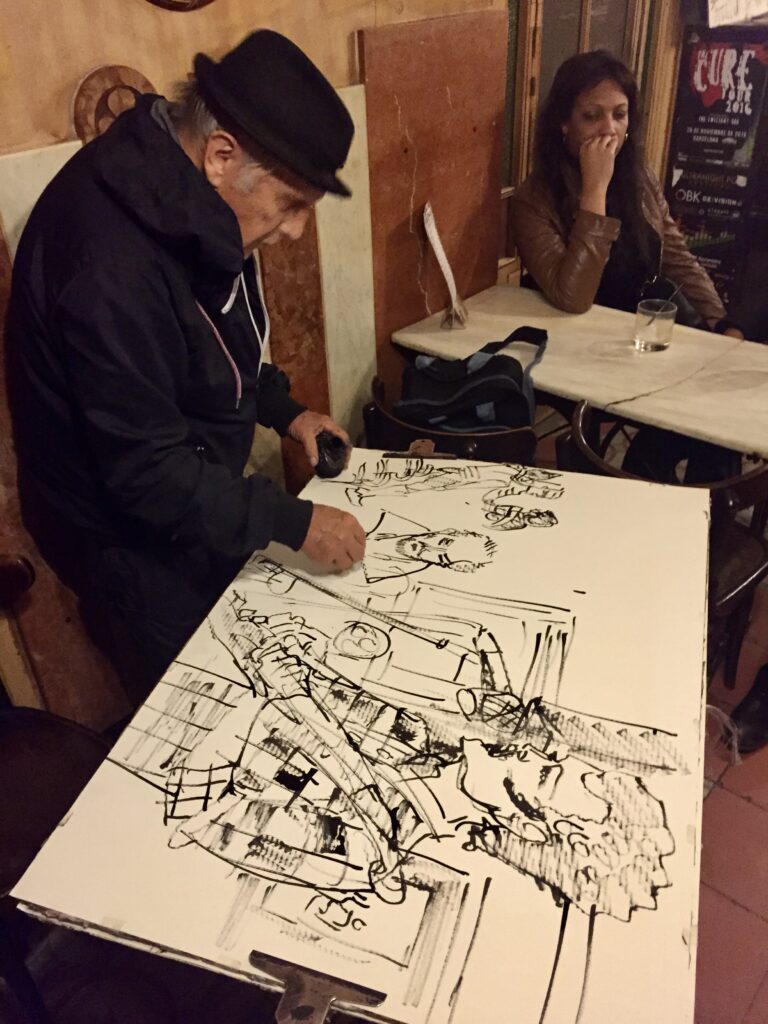
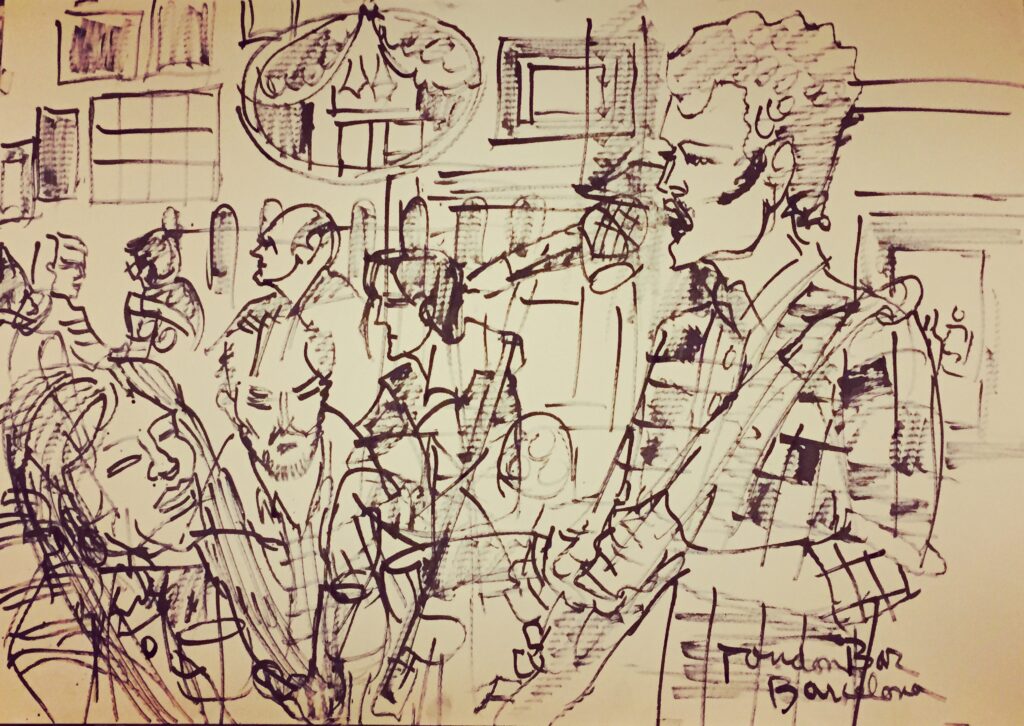
Owen returned to Berklee after taking a year off but lasted only one semester before quitting. With so many songs under his belt he wanted to record and, while living back at his childhood home, he began learning the art of music recording. One day, while playing an outdoor piano on the strand in Manhattan Beach, a guy named Elio Armato approached him. The son of Leonard Armato, an entertainment manager who worked with basketball star Shaquille O’Neal and famed boxer Oscar De La Hoya, he asked Owen if he wanted to make a record with him and they “began a partnership for the next few months, recording, and pitching around.” But nothing came of it and Owen went back to working solo.
The following year, after a gig at the Hermosa Saloon, a friend said he wanted Owen to meet a musician who lived in Hermosa Beach, and that’s when Owen met Mike Pinera. He played a song for Pinera through the tape deck in his car, which Pinera really liked, and in turn he played “Ride Captain Ride” for Owen, a song Owen remembered hearing on the radio but had no idea who had recorded it. Pinera had co-written the song with a Blue Images bandmate in 1970 and the song reached number 4 on the US and Canadian music charts, after which he joined Iron Butterfly when Blue Images broke up. Pinera became a bit of a mentor and when he had that gig to play at the Washington State Fair he asked Owen to join him, which is how Owen found himself playing “In-A-Gadda-Da-Vida”. During this time, Owen also had his own band and played some of the famous bars in LA on the Sunset Strip, including Whisky A Go Go and The Viper Room.

When it came to producing a record, however, nothing worked out with Pinera just as it had not worked out with Armato. In October, 2019, Owen began recording Saint Augustine with a friend who had a state of the art recording studio built in his garage. I asked him in an email how things progressed from there and he wrote, “We worked until February 2020 but then had to stop recording for months due to Covid. During that Covid shut down I began repurposing my stagnant creative energy into other songs. Finally Covid shutdowns ended and I was able to wrap up Saint Augustine in the summer of 2020. A few months after finishing, towards the end of summer 2020, I started to feel like I got the album wrong. It felt as if the songs on Saint Augustine had deviated too far from the original spirit of the songs. So in October of 2020 I began recording the other songs that I had fleshed out during the shutdown, but this time I decided to record it by myself. One thing led to another and before I knew it I had a new album, which I named Right As Rain. Right As Rain felt right to be released and took the spot of Saint Augustine. The singles came out in the summer of 2021, and then the full album in early 2022.”
The Covid year, 2020, brought a lot of change to Owen including the fact that he learned the TM practice, although he did have to be masked during the course. He’d been watching and listening to David Lynch on YouTube talking about creativity and the link to meditation. Like Lynch, Owen came to see the twice daily meditation practice as an insight to what’s beneath.
Once he had finished Right As Rain, Owen secured a record deal with an independent label called Epictronic, based in Rome, Italy. “I had high hopes that Epictronic and the head of the label, Carlo Belotti, would be able to market the album in beneficial ways I couldn’t do on my own.” After a year, however, it became apparent that the hoped for support was not coming and Owen left. He went back to releasing the music himself which means “doing everything I can to give it a chance to make an impact. My first single, for instance, was a song called ‘Green Light’. By the time I released that song I had a music video made, press outlets secured, music streaming playlists placements, and Google ad campaigns in place. Essentially, as many elements in place so that when the song was made public, on the internet and some college radio, I’d done as much as I could to get momentum behind it.”

He followed a similar process with Saint Augustine when he released that album in 2024, the year he met his girlfriend Alexis. When I caught up with Owen to do this profile, he and Alexis had just left LA for Oregon to make their own life together. The night we spoke, they’d arrived in time to celebrate his grandmother’s 97th birthday. His mother’s side of the family is from Oregon, most of them still reside there, and he has fond memories. “Growing up my family used to come up routinely for Thanksgiving as well as summers. I guess my extended family is fairly large. I enjoy getting to visit with them and am looking forward to have more opportunities to do so now that I am so much closer.”
We talked a little about Owen’s third album, which he’s putting the finishing touches on, and he is in the midst to see if he can find another record label to market it, given he does have a few connections with music business executives. Of course the music business has been in great flux for quite a while now so time will tell. During our back and forth discussions, I was curious to understand his approach to songwriting and recording and he used “Stand Tall”, a song that will appear on this next album, to outline his process for me.
“‘Stand Tall’”, he says, “began with an alternate guitar tuning. One evening I was playing around with this particular alternate tuning and I discovered a chord progression, melody, and lyrics pretty much fluidly. It didn’t take very long and felt good in the moment so I recorded a little clip of myself playing the song I’d just written. After that I forgot about ‘Stand Tall’ for 10 years or so and didn’t rediscover it until Covid lockdown. Upon rediscovering the clip of ‘Stand Tall’ from years earlier, I decided to make a proper ‘demo’ of it because I thought it had potential.
“For me a ‘demo’ is like a blueprint: it roughly outlines how the song begins and ends, and provides a loose guide for what happens in between, while still leaving room for the song to evolve. I recorded that demo during lockdown, then set it aside again for a couple more years. When I began work on what would become my next album in late 2022, I revisited ‘Stand Tall’ and decided it belonged on the record. Using the demo as a blueprint, my recording process tends to move through cycles of expansion and contraction. The expansion is experimenting with all the different avenues I think the song could go in, most of these experiments don’t make the final version but I need to explore them to know that for sure. The contraction part is allowing that initial spark of the song help me remember… remember the heart of the song and what might be constricting or taking away from that heart’s beat.”
On that track, “Stand Tall”, Owen provided vocals, acoustic guitar, electric bass guitar, Cello (synthesizer), electric guitar, slide guitar (both acoustic and electric) and shaker. Everything but the drums, “which were generously contributed to the album by an old friend. For mixing I worked with a mixing engineer, and for mastering, a separate mastering engineer. Both of which took the album up to new levels.”
So there you have it, Owen Hamlin’s approach to writing and recording his music. And you can see the process stretches over time, his song “Stand Tall” spanning nearly fifteen years. I’ve listened to his music many times although the only song I’ve ever seen and heard him play live, on acoustic guitar, twice actually — once at the TM Centre and once in a LA friend’s living room — is the Maharishi Mahesh Yogi inspired “Across The Universe” by The Beatles. Like John Lennon before him, Owen sings Jai Guru Deva, Om
Settling into Oregon with Alexis, another album about to hit the world, who knows what time will bring. I am confident, though, that Owen Hamlin will stay true to David Lynch’s advice: Keep your eye on the donut, not the hole.
If you are interested in following Owen’s career and listening to his music you can start with his website.
Next up is Ariane Blackman, poet, researcher, traveller, seeker, grandmother, mother — and daughter of a Holocaust survivor. In 1950, barely more than a toddler, Ariane left
Łódź, Poland with her mother as they eventually made their way to Canada by way of a kibbutz in Israel and a French pension in Paris. Well into the twenty-first century Ariane is still trying to find ways to tell her mother’s stories.
I hope you come back.