

“I like learning. I don’t like being schooled.” A distinction that provides insight into Renée Sgroi, a recently retired college professor who has now created her own business — writing workshops and coaching — to help others find their writing voice. To help people learn, self-discover, and not be “schooled”. Remembering back to the time when she’d been accepted into the gifted student program in elementary school, Renée felt like it provided freedom. But she left the program later, in high school, because she encountered something that seemed ridiculous. “In high school the program was different. They wanted us to work on an extra project for a quarter of a credit. And I was like, ‘You people are dumb. Why would I want to do extra work for a quarter credit when I can take a regular class and get a full credit.’” Apparently the administration was surprised when the person who’d they viewed as extremely intelligent called them out on their own flawed structure. So, perhaps, another insight into Renée: don’t tell her she’s gifted and then treat her like an idiot.
I was aware that Renée was a professor at a Toronto area college when I first met her on Zoom calls during our shared Annex Writing Circle experience in the time of Covid, but I assumed her academic expertise was science and that she came to poetry from that background. My premise, I suppose, came from a long, innovative poem Renée shared called “MIXED-METHODS EXPERIMENTAL STUDY OF ACER SACCHARUM IN SITU, WITH PROGNOSIS BY ARBORISTS AND LINGUISTS ON THE FUTURE OF INTERSPECIES COMMUNICATION: AN INVESTIGATION”. I had it backwards, of course. She came to the poem as a Humanities professor, an academic, a person with a life-long curiosity toward language and culture.
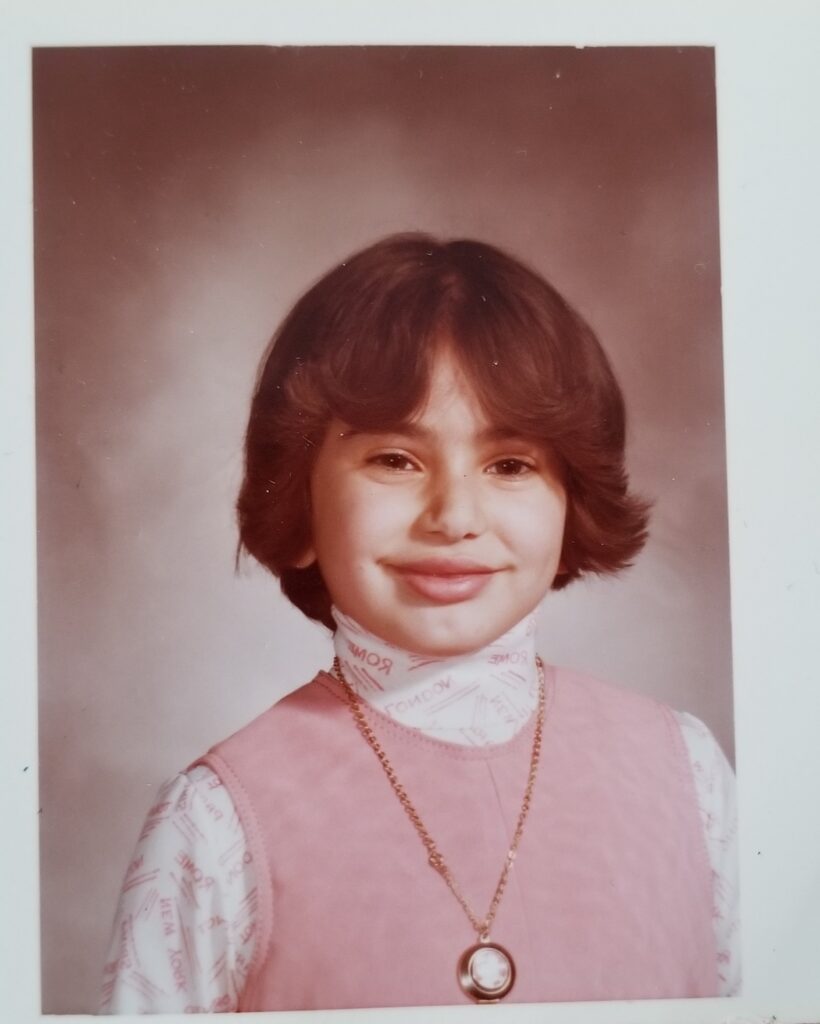
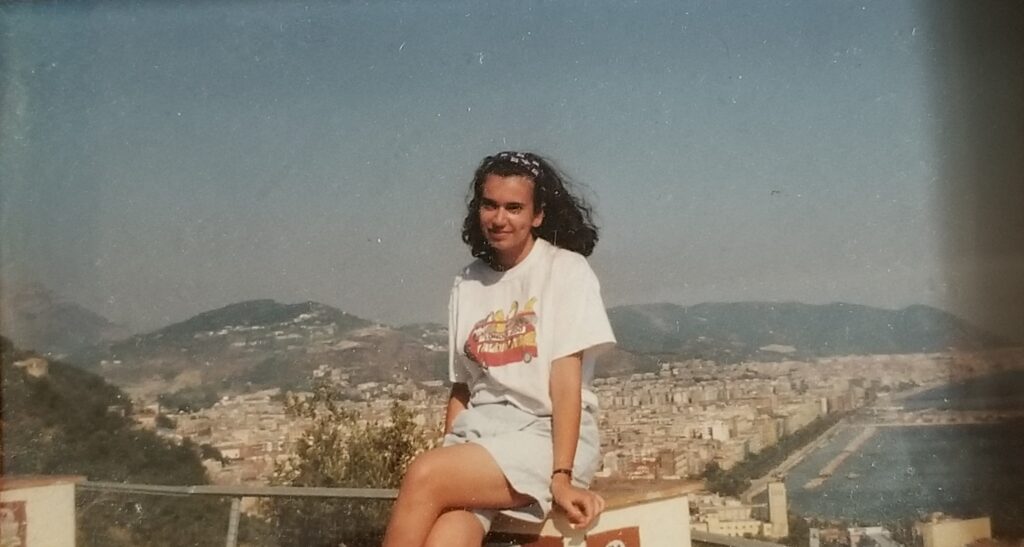
Born to an immigrant family in Toronto, Renée grew up in Willowdale, which is in North York. Both sides of her family began to immigrate from Italy after the Second World War, although at different times. “On my father’s side, my grandfather came probably around 1949. He came alone, just working whatever jobs he could find, like as a grave digger, until his oldest son joined him about a year or so later, and then at some point his second son arrived.” Renée’s father did not see his own father for seven or eight years until he himself travelled across the Atlantic with his mother and younger brother. Eventually, her dad’s sister and her family also immigrated. Her maternal grandfather died when her mother was four years old and her older brother, Renée’s uncle, came over first. “He worked on one of the railways for two years, and then eventually came into Toronto, and then my other uncle came over, and then my aunt, and, eventually, my mother and my grandmother and another aunt came. It’s one of those situations which still happens today. One family member goes and establishes some roots and eventually everybody else is brought over.” It happens that the families were from the same town in Calabria, in the southern end of Italy, but Renée’s parents were strangers there and did not meet until much later in Canada. However, Renée says, “my grandmothers vaguely knew each other.”
Although raised Catholic, her skepticism toward received authority presented itself at a young age. “Even in elementary school, they would line us up in the hallway to go to confession. You had to wait your turn, then go in and see the priest. It was always this weird thing. I was like, ‘what did I do? Why do I have to tell you this?’ Then the priest would tell you to say so many prayers, and I was like, ‘I don’t even know what that prayer is’. It got to the point in elementary school, while I couldn’t escape mass because they would just bring everybody into the gym, for confession I would start hiding out in the bathrooms. Then in high school, I started hiding out so I didn’t have to go to mass. So yeah, I was not really a believer.” Also, in Renée’s view, while Italians are often associated with Catholicism, there exists a difference between the north and the south. “Southern Italians, as far as I’m concerned, are much more superstitious than they are religious. It’s not really about their religion, it’s more about ‘I need this saint’s image for protection.’ I really feel in our heart we never abandoned paganism.”
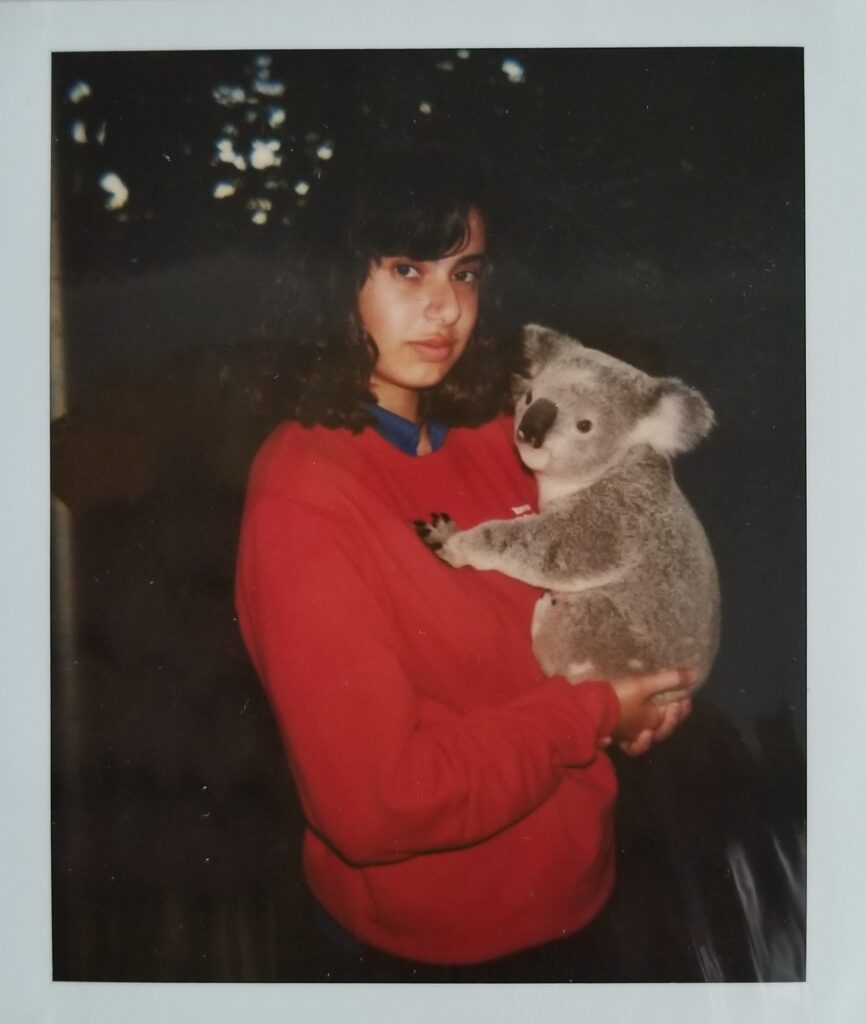
Renée’s use of the pronoun “we” in that last sentence is important — she feels a strong attachment to her Italian heritage, the sense of being raised in an immigrant family and, with that, a profound sense of culture, what culture means, why culture is fundamental. “When you come from an immigrant family,” she says, “you feel like you’re trying to get a handle on what everybody else seems to know that you don’t know.” At the same time, “there was a strong connection to the cultural underpinnings, the cultural fabric my family brought with them.” The working class, immigrant neighbourhood where she lived was made up of diverse immigrant families and, in Renée’s view, “it’s hard not to notice culture when you grow up in that kind of environment.” There is also the fact that she was the second youngest of four children and had the opportunity to learn what her older sister and brother were learning. “My mother wanted us to have music lessons. I think I was about six. My sister taught me how to play the melody for “Heart and Soul” and she played the harmony on the little keyboard we had at that time. My mother found out that the nuns at a nearby high school actually had a music studio and were accepting music students. We had to audition and I went up there with my sister and did my little thing. They couldn’t believe that at that age, I was able to actually play by ear. I ended up taking music and piano lessons for 14 years.”
That early influence also spilled into reading. As a child, Renée read beyond her years and early on fell in love with Agatha Christie. By grade six she asked her mother to buy the entire Agatha Christie collection, which was available through Reader’s Digest, and her mother said, “I will get them as long as you read them.” Remembering that, Renée says, “That wasn’t a problem.” Beyond her infatuation with those mystery novels, Renée began to read her sister and brother’s high school books and, once in high school, read her sister’s university books. Yet for all that education, she is quick to point out that she “didn’t grow up in a home listening to Beethoven or going to art museums. If anything, we listened to Don Daynard’s “Golden Oldies” on Saturday nights on the radio, Italian music from the sixties and seventies, and the Bee Gees and ABBA. I didn’t know CBC radio existed until I was in graduate school!”
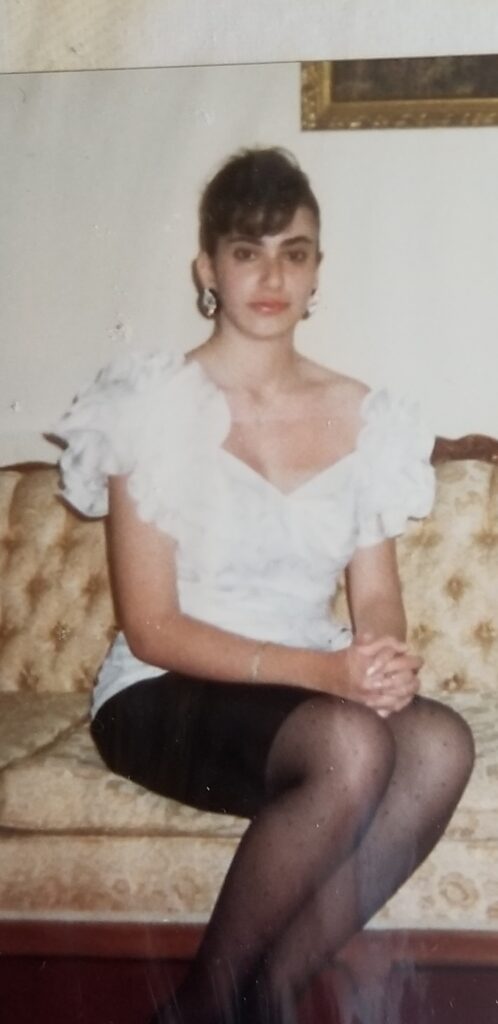
Graduate school came in the form of the University of Manitoba, an educational experience bookended by the University of Toronto. She received her Honours Bachelor of Arts in English Literature there, as well as meeting a fellow student who she would later marry, and then returned to earn her PhD. Nearly twenty years later she obtained another Master’s degree when she took a sabbatical from work to study Creativity and Change Leadership at SUNY Buffalo State. She taught at a couple of Ontario colleges while working on her PhD and, after receiving her degree, landed a contract with McMaster University. But commuting every day to Hamilton from the east side of Toronto became untenable once her second daughter was born. As Renée puts it, “my life was already crazy,” and by 2008 she ended up full time at a college closer to home. Then, in 2010, her marriage ended. She said that while life was busy working and raising her daughters, “one of the secrets of being a single parent, if the other parent is of any value whatsoever, is that you actually get every other weekend to yourself. So when we split up, I found a little writing group and I was able to go to some meetings and to really start writing.”
Active with the group beyond sharing her writing, Renée became president of the Brooklin Poetry Society for a couple of years. In 2013, they published an anthology called Crossing Baldwin. “Lingualossa”, one of her early poems, appeared. It is the name of the Sicilian town on the slopes of volcanic Mt. Etna where her paternal grandfather was born. When the poem was again published as part of Renée’s first collection, life print, in points, a footnote explained “It is believed that the town of Linguaglossa, Sicily, derives its name from the Latin “lingua” and the Greek “glossa” which in both languages means “tongue”, and therefore refers to the two dominant groups that lived there.” A grandfather’s birthplace translated to English as “tongue tongue”, connecting Latin and Greek — ancient language, ancient culture, coming to be explored by a Canadian born and raised granddaughter. Canadian itself becomes interesting culturally as Renée notes that she grew up with a French first name “chosen because my parents wanted a Canadian name that, at the time, most English-speaking people in Toronto were unfamiliar with and couldn’t pronounce (not to mention my own Italian extended family), and then with a surname that I’ve discovered over the years, even amongst Italian people I encounter also don’t know how to pronounce or recognize as Italian. That has meant a lifetime of pronouncing or spelling my name for people, and saying it again and again. Most people tend to think Sgroi is Slavic, or Hungarian, or something like that. No one ever guesses Italian.” However, upon visiting Sicily, she “discovered that in the area around Mt. Etna there are many people with my surname. When I went up to a hotel desk to confirm my reservation it was probably the first time in my life that the sound of my surname in a stranger’s mouth sounded beautiful and mellifluous. I’d go back to Sicily for that alone.”
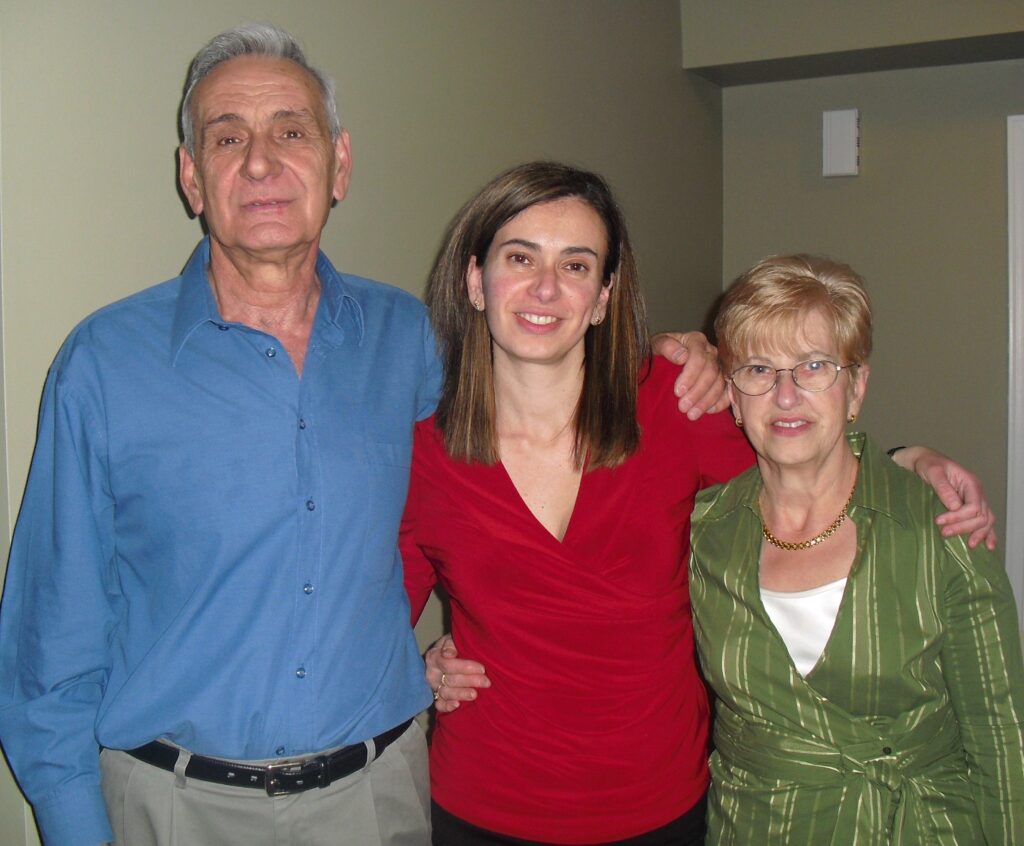
For me, when I reflected on Renée’s life after our interview while also thinking about her poetry, a through-line emerged that connected the perception of culture at a young age with the adult who went on to investigate what the term “culture” could mean through academia. A first year course had provided her with the four disciplines of anthropology: biological, cultural, linguistic, and archeological. Then, after an introduction while doing her Master’s, Renée pursued the interdisciplinary field of Cultural Studies during her PhD. I see this personal and academic awareness of culture often emerging in her poems.
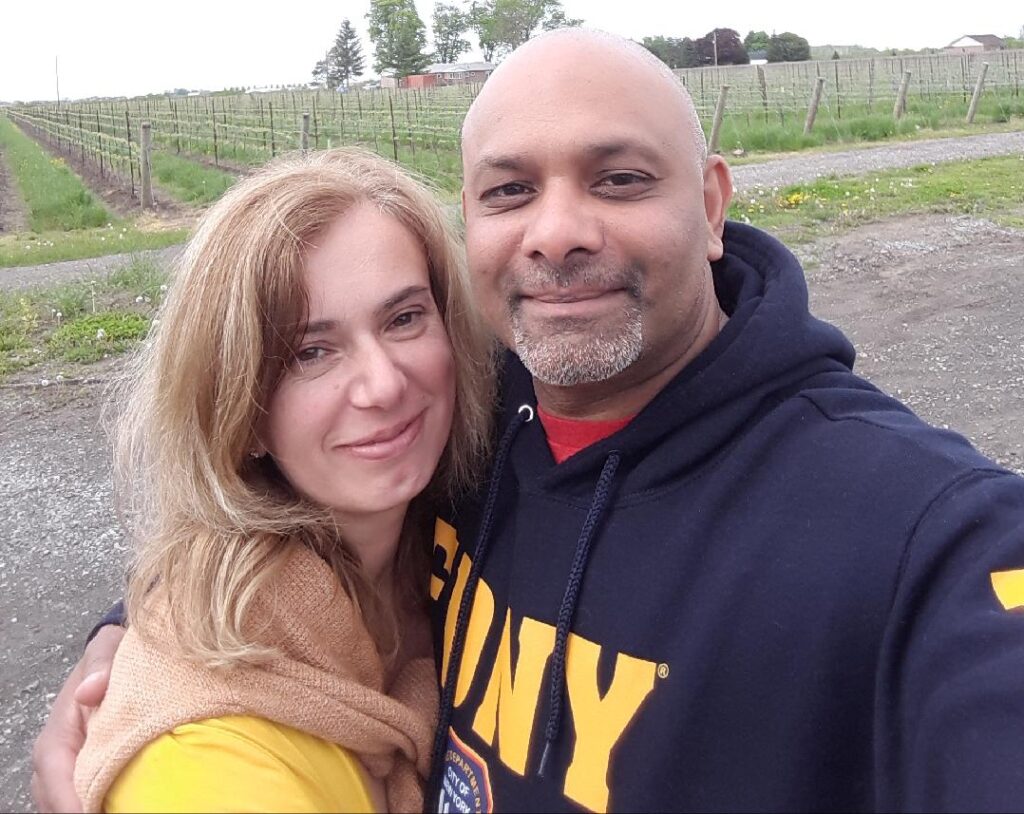
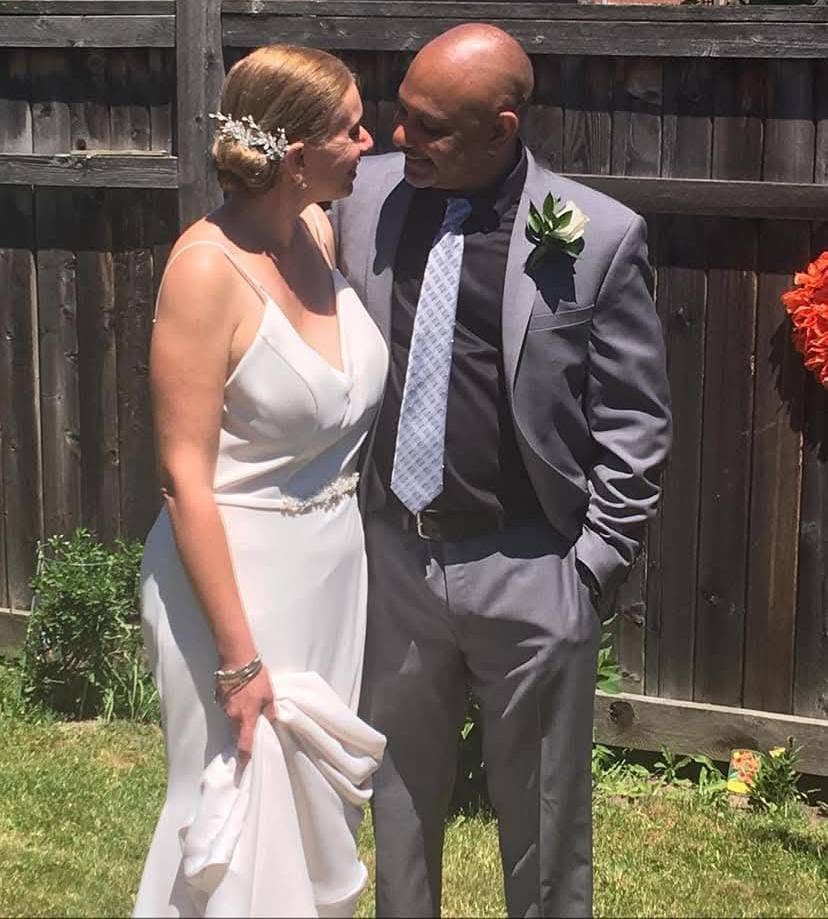
To speak only in terms of family as culture, of course, does not capture the deep connections of everyday life. Such as her marriage to Raj in June, 2020, a chemist she met through a dating app — twenty-first century romance indeed, even getting married outdoors in the midst of Covid. Together, Raj and Renée have also weathered some of life’s traumas and grief. That first collection of poetry is dedicated to the memory of her mother, Adriana, who died before its publication. “I was in the room when my mother passed away,” Renée said. “It was traumatic. Devastating.” As I came to know her after life print, in points was published,she began to share that her daughter was suffering from an eating disorder. We would talk about it because some clear images of harrowing moments driving to the hospital came through in new poems and at one point Renée said, “I thought we were going to lose her.” Renée went on to explain that even after witnessing her mother’s passing, “nothing compares to when your child is sick.” Her daughter did recover and is fine now.
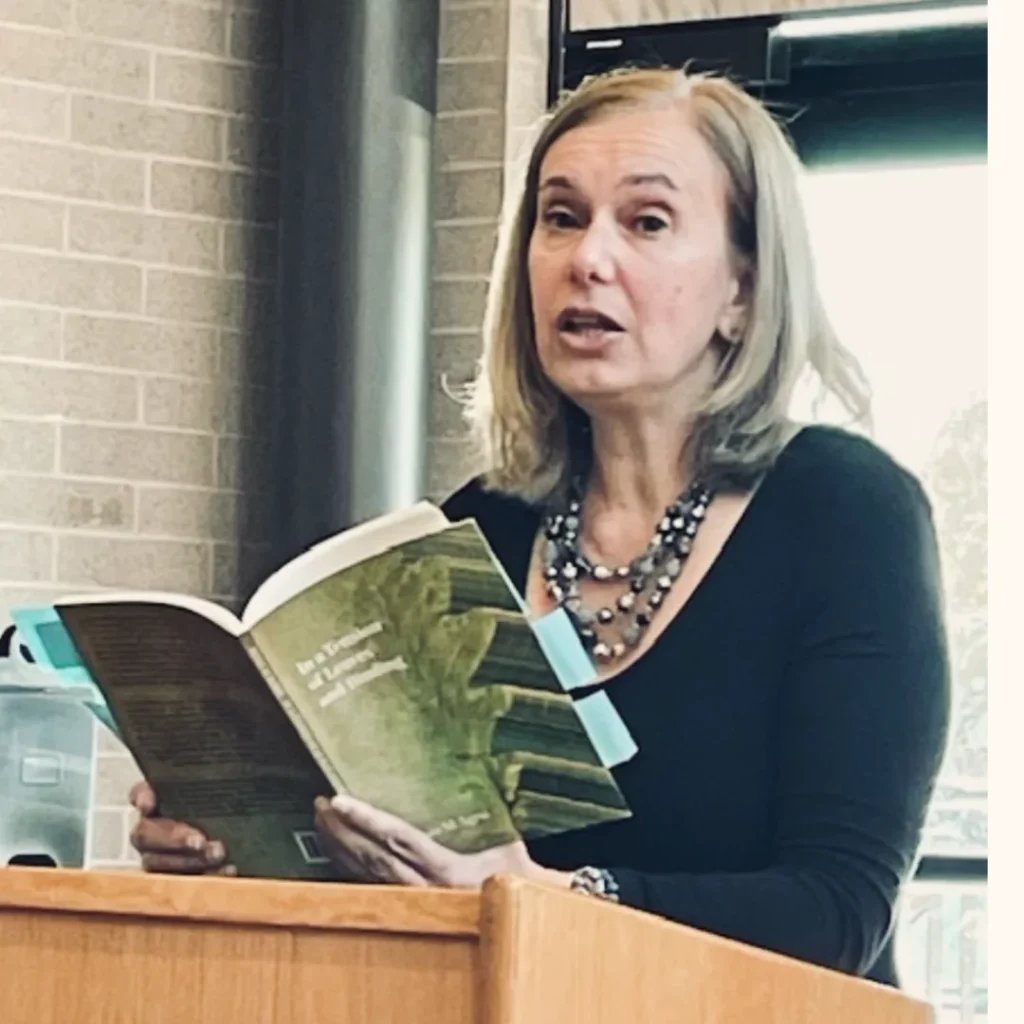
In 2024, Renée’s second poetry collection, In a Tension of Leaves and Binding, was published. “I realized I was writing a lot about nature and thought I could put something together and applied for a Sage Hill workshop residency. But then I realized I was actually writing about grief. I think the book is very elegiac.” Nature, grief, language — all entwined, that tension of leaves and binding. Reflecting on the time of Covid, she wrote of loss: “I lost my mother four months prior to the pandemic….What is loss? In nature, there is loss and life, each new day.” Of nature, she “began to imagine what it might be like to be an eastern cottontail rabbit, a worm, a tomato on the vine, ripening….What is the language of nature?” And of human language she came to think of classification. “What is the meaning of classification?…Latin, the supposedly ‘universal’ classificatory language….We live in a world where we are only beginning to understand the consequences of classifying.” Finally, she concludes by writing of herself in the third person: “The poet believes her fascination with language derives from the fact that her grandfather was born in a town called Linguagloss, both lingua in Latin (or Italian) and glossa in Greek meaning tongue. She has written about this elsewhere, in another poem, in another collection. She allows these tongues to become part of her mythology.”
And so I come back to my reflection of Renée’s life through her poetry, the deeply personal, the cultural, the fascination of language. Writing as exploration, as a method to work things out, poetry or prose, to understand every story of self — no matter how true — is mythology. Of the many writers I have come to know, to me there appears within Renée a continuity, a life-long immersion in language long before she sought publication, that while not unique is rare. A constant coming to terms with herself and the surrounding world, academia and family life woven together through language. Due out in late 2027 is a new poetry collection to be published by Frontenac House. Renée told me that it’s a reworking of the Demeter and Persephone myth. The digital library website, Theoi Greek Mythology, provides this summary: “The Demeter and Persephone story tells of the deep connection a mother shares with her daughter. It also tells the story of a young girl who comes of age and falls in love with the dark god of the underworld.” We can reimagine that ancient myth as a story of a contemporary mother whose daughter suffers from the throes of an eating disorder, and nearly loses that daughter to the darkness of death. The poem that she shared in our Annex Writing Circle during that time, “we drive our blue car to the hospital”, will be included in the collection, having previously been published in Augur Magazine (issue 7.2, 2024). As I reread it I recalled the imagery, the blueness of the world described:
“on an open road, like a holiday. this is not a holiday. it’s a marathon, we’re told, as we race, redefine battle: blue fingernails, car under blue sky, blue hospital curtains, all the cerulean, sapphire material we stitch into this narrative, this patchwork quilted anticipation, embroidered uncertainty, appliquéd blanket that rests on your shivering shoulders, turquoise-striped and weighted.”
I should also note that Renée’s focus on caregiving goes beyond experiences with her daughter; she has been assisting her husband in the last couple of years. I had the pleasure of first meeting Raj at an Authors Toronto event in 2024, but shortly after that he required an emergency quadruple bypass that led to two strokes and lasting seizures. Complications have arisen that have left Raj with permanent disabilities. As always, Renée is there first as caregiver but the understanding, the working-out of things, comes from writing. In this case, now, she is working on a memoir centred around caregiving that she recently workshopped at another Sage Hill Workshop.
Many years ago a friend in another writing group had introduced her to the Amherst Writing Centre in Massachusetts. In building a retirement plan Renée signed up online two years ago for the Artist’s Training offered by the centre. Within the heart of all the stress, the chaos, lives the creative and, as she moves forward, she has started the writing workshop and coaching business. But in guiding others in their writing she will also be helping herself. When we talked about her previous experience with students, Renée laughed and said, “You know, one of the things I learned over the many years of teaching is that I’ve probably learned so much more than my students. Because you do, you learn what you’re teaching.”
So the writing will continue, and the learning, the teaching, the exploration of life, and living a life with all the challenges that come with it. New collections of poetry published. Perhaps a non-fiction book, the memoir. Perhaps even fiction — she does have an unpublished novel. In 2019 she was on the short list for the Guernica Prize for Literary Fiction, an annual contest by Guernica Editions. Guernica did not publish that novel but they did publish her second book of poems. So goes the circular life of writing, of looking to be published, of more writing and hopefully more publishing. In searching for a conclusion to this profile of my good friend Renée Sgroi I decided to quote the last poem of her first poetry collection:
The table is cleared
and we begin again
to place the settings, prepare
for our unknown guests
Next up is Sandy Smith. Born in the Bronx in 1932, she began her nursing career in the early 1950s at Bellevue in Manhattan, the oldest public hospital in the USA. When not working, Sandy considered a bevy of beaus from Broadway to Miami to Halifax, Canada, before meeting the man she would marry in the Borscht Belt — that famous Catskills collection of resorts. After 57 years of marriage, Arthur died in Santa Monica, where she continues to live, now able to enjoy her first and only grandchild born just three years ago when Sandy was 91.
I hope you come back.